our story

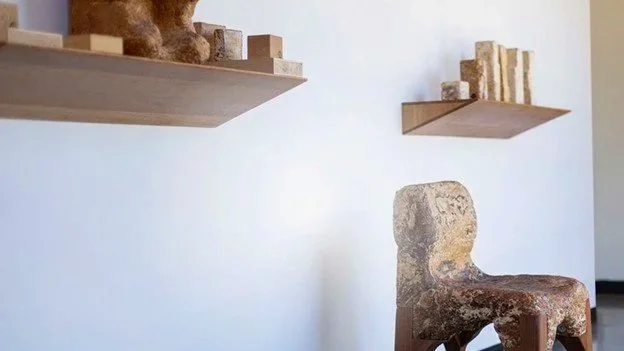
  • Two wooden floating shelves holding bricks of various types and sizes on a white wall, and an old, worn stone chair in the foreground.

    Origins: a biotechnology cofounded by artists

    1990-2013. In the 1990s, inspired by the beauty and life cycles of mushrooms, artist Philip Ross began cultivating mycelium as a creative material. Through reishi, Phil uncovered a rich diversity of form, texture, and color shaped by light, air, gravity, and temperature. With culinary precision and a naturalist’s eye, he developed his signature “biotechniques,” growing living works of art. His pioneering research gave rise to mycotecture—a term he coined in 2008—and his artworks, patents, and publications laid the foundations of mycelium material science, with exhibitions at institutions including MoMA and Kunsthalle Düsseldorf.

    As global interest in his material innovations grew, Phil partnered with longtime collaborator Sophia Wang—an artist, educator, and writer who first encountered his mycelium sculptures in 2007 and immediately recognized their expressive and cultural potential. With a fluency spanning living systems, visual arts, and literature, Sophia understood the power of art and storytelling in bringing mycelium to the world. In 2013, together with a small team of artists and fabricators, Phil and Sophia co-founded MycoWorks, transforming Phil’s San Francisco studio into a workshop laboratory and advancing his biotechniques into what would become the company’s founding technology.
  • A person handling large sheets of aged, yellowed leather on a wooden surface.

    A Growing Movement with MycoWorks: art and design meet material science

    2014-2025: As MycoWorks drew the attention of leading fashion and footwear houses worldwide, invitations poured in to create the first products made from mycelium. To meet this momentum, Dr. Matthew Scullin, a materials science entrepreneur and co-founder of Alphabet Energy, joined MycoWorks as CEO, guiding the company through its first major phase of growth.

    MycoWorks expanded to multiple production sites from an art studio to various garages, to a 30,000-square-foot pilot plant and ultimately to its 136,000-square-foot factory in Union, South Carolina. With this factory, MycoWorks sought to bring mycelium materials to the world at scale.

    In October 2025, MycoWorks CEO Matthew Scullin in an open letter to the mycelium industry and its stakeholders, announced a company restructuring. The changes included winding down the company in its current form and shifting from growing mycelium to sourcing and tanning mycelium in a new operation launching Spain, emphasizing that this evolution is necessary to scale the industry, reduce costs and advance adoption.

  • The image is extremely blurred and indistinct, making it impossible to determine specific objects or details.

    HYPHAEN: the nexus mycelium materials have needed to scale adoption.

    2026—Onwards: Biomaterials can only scale in partnership.

    A bridge for the mycelium industry’s key players–growers, tanneries, and brands– and an inside partner to accelerate R&D, HYPHAEN is leveraging over three decades of expertise across mycology, manufacturing, and process development to provide scale-up support to clients across industries. 

    We’re ready to make mycelium leather a reality.